“Common Pests Identification & Facts”
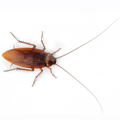
Cockroaches
Cockroaches are well known for moving from place to place in boxes or bags, on clothing and only one egg carrying female to create an infestation. Given a suitable environment - warmth, humidity, food, water, and secure housing - German Cockroaches can expand in numbers almost exponentially. The American Cockroach usually breeds in underground utility networks and sewer systems, from which it then may move into other structures, favoring areas of high humidity like sewers, steam tunnels, boiler rooms, and basements, especially around pipes and drains.
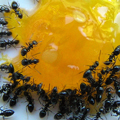
Ants
An ant colony will usually be established outside in an underground nest with numbers of ants in the colony ranging from a few dozen to many tens of thousands. Ants prefer to live outside and the usual reason for finding them indoors is because they are foraging for food – hundreds of feet from the nest in some cases. Ants can be very resolute pests and will find many different ways to get into your home – coming in through gaps in door frames, eaves, window frames, utility lines and plumbing.
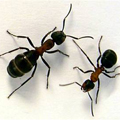
Carpenter Ants
Carpenter ants are among the largest ants in North America with workers of C. modoc and C. vicinus ranging from 1/4 to 1/2 long. They have only one bulge at their narrow “waist” (the single node on their petiole) and an evenly rounded back, when viewed from the side (known as a smooth dorsal thoracic profile). The western black carpenter ant, C. modoc, is uniformly black with dark red legs, while C. vicinus varies in color but usually is red and black. A smaller, yellow and black species, C. clarithorax, which also is common in California, ranges from a little longer than 1/8 of an inch to not quite 5/16 of an inch long. Carpenter ants can't sting but can inflict painful bites with their powerful jaws and spray formic acid into the wound, causing a burning sensation. Homeowners might confuse the winged males and females that leave the nest on mating flights with termites. However, you can distinguish between ants and termites by the differences in their antennae, waist, and wings. Also, carpenter ant sawdust is fibrous versus the 6-sided shaped pellets of drywood termites.
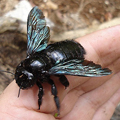
Carpenter Bees
Carpenter bees build nests in wood, creating galleries that can weaken structures; however, they rarely cause severe damage. People may be frightened by carpenter bees because of their large size, their similarity to bumble bees, and their annoying noise. Most carpenter bees, Xylocopa spp., are large and robust insects resembling bumble bees. They are usually about 1 inch long and colored a metallic blue-black with green or purplish reflections. They differ from bumble bees in that their is shiny with fringes of hairs on some segments. Males of some species are lighter colored, ranging into golden or buff hues.
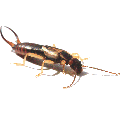
Earwigs
During the hot and dry summer months, earwigs will often attempt to migrate indoors. Earwigs prefer warm, temperate climates and dark and damp areas. If an earwig can find an entrance into your home or business, they can find an abundance of warm and damp areas to survive and reproduce. Earwigs are nocturnal and normally spend days hiding in small, dark and especially humid places around your dwelling, usually in your basements, bathrooms and kitchens. During the evening hours, they will feed on plants and other arthropods including mites and fleas. If you already have a pest infestation, this can increase the probability that you will soon have earwigs too.
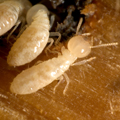
Termites
Termites are small social insects that feed on cellulose from dead plant material, usually in the form of wood, animal dung, soil, or leaf litter. Around 10% of the estimated 4,000 species are significant as pests that can cause serious structural damage to buildings, plantations or crops and also cause significant economic woes. Scientists believe termites have been around for over 250 million years, living in colonies above or below ground. Termite mounds are the product of the colony getting too large for the initially unseen, underground nest and the mounds grow in size with the colony concealed within. Other termites burrow into wood to find shelter and create a nest environment and one of the tell tale signs of this is the small mud tubes they build to gain access to wood material.
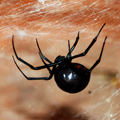
Spiders
Spiders are of the order Araneae and are arthropods that have eight legs and six or eight eyes and distinct mouthparts that are modified into fangs that have the capability to inject venom. Spiders are found all over the world, and more than 40,000 different species of spiders have been identified. Spiders have the ability to extrude silk from their abdomens, which allows them create webs to help catch their prey. Spiders prey on insects and other spiders, although some larger species have been known to take birds and lizards. There are a few species that are social and build communal webs to house anywhere from a few to 50,000 individual spiders. Most spiders live at most two years, although some of the larger spiders can live up to 25 years in protected spaces. Adult female spiders are larger than their adult male counterparts, sometimes dramatically larger. Males can be recognized by the presence of an enlarged pair of ‘palps’, or mouthparts. Male spiders are the ones that are more commonly found in homes because they tend to disperse during the mating season in search of females. Spiders come in many different shapes and sizes, some are smooth, some have a light ‘fur’ covering their bodies and legs. Spiders come in many different colors and can be found virtually everywhere.

Mice
Mice are commensal, meaning that they share space and habitats with humans and depend on us in part for their survival. Mice are always looking for food, water and shelter for survival, and have been known to enter dwellings through very small holes, sometimes holes smaller than 1/4" in diameter. Rodents have the capability of entering a structure through tiny and unpredictable places and since most structures are not sealed appropriately, rodents often have no trouble finding their way inside.
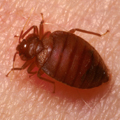
Bedbugs
Bedbugs (Cimex lectularius) are ectoparasites which strictly feed on blood. Bed bugs are aptly named because they normally hide in mattresses, or as close as possible to their human host to enable easy nighttime feeding. They are very small insects about 3/16 inch in length, flat, and broadly oval. They are excellent hitchhikers and are usually unknowingly transported in or on luggage, clothing, or other belongings that are carried by people as they travel. Current outbreaks have been traced to increased domestic and international travel. This is a particular problem for hotels, motels, and apartments, where turnover of occupants is always constant. Bed bug Infestations can also occur inadvertently by bringing bed bug infested furniture, mattresses, or used clothing to one's household. Bedbugs may also travel between units in multi-unit buildings after being brought into the building by one of the aforementioned routes. Bedbugs may wander between adjoining apartments through voids in walls and holes through which wires and pipes pass.
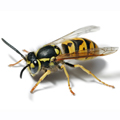
Wasps - Bees
Stinging insects such as wasps, yellow jackets and hornets are all insects that belong to the order of insects known as hymenoptera. They are considered as beneficial insects as they are pollinators and some parasitic wasps are even being used in agricultural pest control as predators that seek out and destroy crop damaging pests. Depending upon the specific species, nests are built in trees, shrubs, or in protected places such as inside human-made structures (attics, hollow walls or flooring, under porches, eaves of houses and in sheds), or in mouse burrows, soil cavities etc.
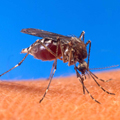
Mosquitoes
Mosquitoes are actually a type of fly and are characterized by their thin bodies and wings as well as their long legs. Of the many mosquito species the Asian Tiger is the type most commonly encountered in our region. They appear in shades of brown and black and generally have paler bands on their bodies and legs. Size varies but an adult may reach about ½ inch in length. Only female mosquitoes are known to bite and will take a blood meal from humans and animals in order to develop her eggs. Generally mosquitoes are a problem if you have standing water on your property. Female mosquitoes lay their eggs on or near standing water which includes clogged gutters or drainage ditches as well as bird baths and tree cavities. Any where that rainwater may collect is an ideal mosquito breeding site.
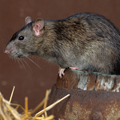
Rats
Rats are known to carry a number of diseases including mycoplasma – a genus of bacteria which can cause pneumonia and other respiratory disorders - as well as parasites and mites but primarily cause damage to property and destroy food.
Don't hesitate when it comes to protecting your home. Call a professional! Call